Showing posts with label China. Show all posts

Saturday, January 5, 2013

Altay, China


I got this card from ConEtoiles for the favorites tag. I've gotten a lot of beautiful cards from her and this is definitely one of my favorites. :) It shows Kanas Lake, among the Altai Mountains in the Xinjiang region of China. Many Tuvan and Kazakh people live in this area, keeping traditional agriculture and nomadic lifestyles alive. (According to Wikipedia.) A beautiful place I would love to visit someday.


I think this is a postal-issued card. The "stamp" on the right is the same image as the card and is preprinted. The one on the left is a takin (Budorcas taxicolor), or goat-antelope, native to the eastern Himalayas, issued in 2001.

I am totally confused as to Chinese postage rates. I've gotten cards from there sent with 3, 3.1, 3.2, 4.2, 4.5, 4.6, and 6 yuen in postage. 3 and 4.5 seem to be the most common. Are those economy and airmail rate differences?

Friday, December 7, 2012

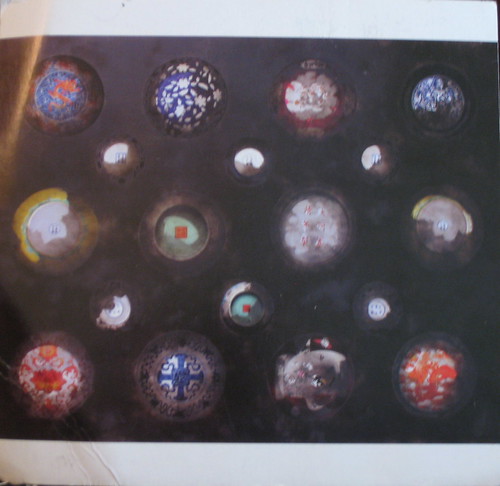
Christian de Lanbodère

IMG_5084
CA-189591
The sender of this card states that she found it at a French art show in Shanghai, China. As such, I'm not sure how to classify the nationality of the card!

However, it was mailed from Canada.
The stamp is from February 2011. It's a painting by Canadian Aboriginal artist Daphne Odjig entitled "Spiritual Renewal."

Saturday, September 15, 2012

Chinese Pandas

IMG_1094
CN-139027

IMG_1108
CN-209297


IMG_6065
Vacation RR from Yue

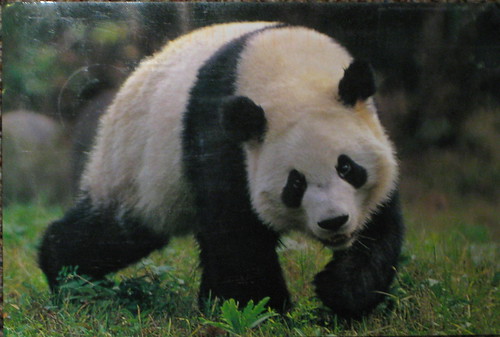
Giant pandas are native to western China. Although they eat meat occasionally, 99% of their diet is bamboo. They are an endangered species, with around 2000 pandas living in the wild, mostly in Sichuan province, where there is a panda protection zone, according to the sender of the middle card above. The Sichuan reserve is a UNESCO world heritage site since 2006. The Sichuan pandas comprise one subspecies; the other subspecies lives exclusively in the Quinling Mountains in Shaanxi province. The Chinese government used loans and gifts of pandas to other nations throughout the 1970s in what became known as "panda diplomacy." Pandas are still loaned to other nations, but with strict terms - US$1 million per year, and any cubs born during the loan belonging to China.

The stamp on the left is in this post.
The one on the right, issued in a 2002 set of two, shows the Ala Shan Redstart (Phoenicurus alaschanicus), a near-threatened bird endemic to China.


The stamps to the left and in the middle, below, are from a 2004 set of four depicting "new look of hometowns of overseas Chinese." The left one shows Xinlong overseas Chinese farm, and the middle one shows Kaiping, a hometown of overseas Chinese.

Finally, below on the right is a 1998 stamp from a set of four on Shennongjia, a forestry district in Hubei province. This one is titled "Primitive Forest."

Friday, March 30, 2012

Chinese Fish


Paintings of Various Subjects
Album Leaves by Xu Gu
the Qing Dynasty

This is one of the oldest postcards in my collection, and definitely the first card I ever received from China. It predates my joining Postcrossing by a fair margin. This is a post for Postcard Friendship Friday, hosted by Beth. Her theme this week is fish/April Fool's Day. I thought about posting a generic spring card (I have a lot of Japanese cherry blossoms, for example), but I thought a fish would be more appropriate. I chose this one because it was sent by a friend rather than a Postcrossing stranger. (Same friend who sent this one.)

After I chose it I noticed that it was postmarked March 31, which is tomorrow (except in 2009). The top two characters on the postmark are the name of the city, Xi'an 西安. The same characters occur in Japanese, where they would be pronounced sei-an, and mean "west peace." The bottom four characters are nearly illegible, but the first two are "Wild Goose Tower" which is a building in Xi'an. I am guessing that together this is the name/location of the post office from which the card was sent. You know, since that is generally what is printed on postmarks.


I love it when people draw artwork on the backs of cards.

Not sure about the stamp. I think it's a definitive. I've gotten it several times. If the characters mean something similar to what they do in Japanese, the theme of the stamp is protecting diverse species.


A post for Postcard Friendship Friday. Click on the icon to go to the page and participate!

Tuesday, November 8, 2011

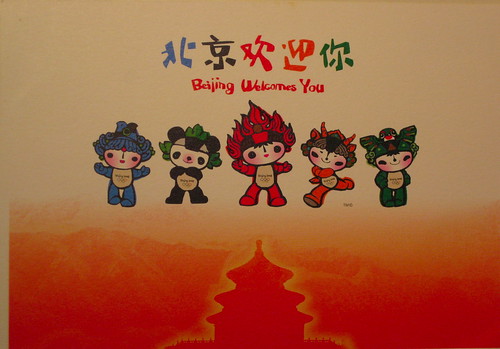
北京欢迎你

Beijing 2008 Mascots
These are the mascots ("fuwa") of the 2008 Summer Olympics in Beijing.
Beibei the fish, Jingjing the panda, Huanhuan the Olympic flame, Yingying the Tibetan antelope, and Nini the swallow.

According to the official website, "Fuwa embody both the landscape and the dreams and aspirations of people from every part of the vast country of China. In their origins and their headpieces, you can see the five elements of nature -- the sea, forest, fire, earth and sky -- all stylistically rendered in ways that represent the deep traditional influences of Chinese folk art and ornamentation."

If you un-reduplicate the names and put them all together - Bei Jing Huan Ying Ni - it apparently means "welcome to Beijing." Cute.

I got the card from the favorites tag, and it was sent unwritten in an envelope. Sad! However, the sender said she was afraid that it would be stolen in the mail, and she didn't have any more copies of this card. I am not sure what the red circular stamps are from. The "stamp" in the top right corner is preprinted.

Sunday, September 4, 2011

Yungang Grottoes, Shanxi, China

Yungang Grottoes UNESCO site

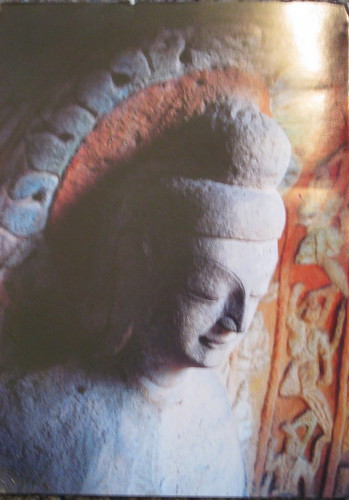
I got this card from one of the favorites tags. I chose it to post because I am currently reading the book Zen Baggage, by Bill Porter. The book is the story of his pilgrimage to the sites connected with the six patriarchs of Zen in China. One of the people in my zazen group recommended it. One of the sites the author visits is Yungang Grottoes, and this is the only place from the book (at least the part I've read so far) that I have a postcard from.

The Yungang Grottoes are a series of caves housing giant Buddha statues built by emperor Wen-ch'eng starting in the 5th century. His plan was to carve five caves, each representing one of the five kinds of knowledge (reality, perfect reflection, equanimity, subtle discrimination, and what works, according to Porter); because the imperial family paid for the project, each buddha was carved in the likeness of one of the family members. Sixty-four years later construction was complete - fifty thousand statues in more than fifty caves. The grottoes were listed as a UNESCO world heritage site in 2001.

These giant statues were about the same size as the presidents' heads on Mt. Rushmore. "Some of the buddha statues at Yunkang were so big the carvers had to use attendant bodhisattvas as pillars to hold up the buddhas' outstretched hands."

Porter goes on to say, "This was not art for art's sake, nor was it about the Buddhist goal of liberation from suffering. This was about inspiring awe and submission to authority... It was great art on a great scale, and I felt honored to have seen it. But I couldn't help wondering if such representations helped people on the road to liberation from the world of red dust or if they only furthered their enslavement to the objects of sensation. I could hear Subhuti answering the Buddha [in the Diamond Sutra], telling him that the Buddha could not be seen by means of the attributes he had acquired. And I could hear the Buddha adding, 'Since the acquisition of attributes is an illusion, Subhuti, the non-acquisition of attributes is not an illusion. Hence, by means of attributes that are not attributes the Buddha can, indeed, be seen.' All I saw were buddhas with attributes. The attributes that were not attributes would have to wait for another day."

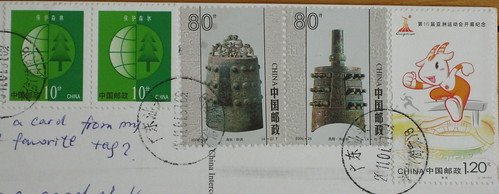
Great stamps! The green ones on the left are from the set "protecting the common homeland of mankind," this one depicting forest conservation and issued in 2002. The two in the middle are "ancient bells from China" from 2000. The one on the left is Su Chime Bell from the spring and autumn period, and the one on the right is Jingshu Bell from the Western Zhou Dynasty. Finally, on the right is a more recent stamp, from 2010, celebrating the opening of the Guangzhou 2010 Asian Games. This one is "athletics." By the way, all this stamp info comes from this site.
IMG_4586

Saturday, July 30, 2011

Xi'an, China

Terra-cotta Warriors

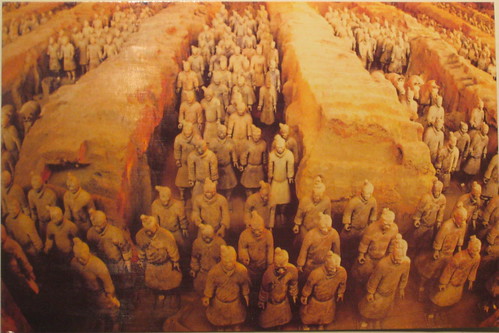
This is the world heritage site near Xi'an that I didn't visit on my trip there. My friend told me it wasn't as awesome as visiting Hua-shan mountain, so I went there instead. But I received a postcrossing official card from there, and here it is.

The armies are found at the tomb of China's first emperor, Qin Shihuang, buried with him and meant to protect him in the afterlife. They date to the year 209 BCE. Buried under 5 meters of soil over the ages since they were created, the figures were discovered by farmers digging a well in 1974. The figures are life-size and include warriors, horses, chariots, officials, musicians and acrobats. They are arranged in military formation according to rank and duty. Wikipedia doesn't say how the musicians and acrobats figure in the military formation...

Just a meter mark, no stamp, so I won't bother to post it.

Monday, May 30, 2011

Yunnan, China


I got this card from ConEtoiles for the favorites tag. It shows the typical life of native women of the Yun-Gui plateau in Yunnan province. I wasn't able to find any info about the people who live there, though. Maybe everyone is thinking that I purposely picked cards I don't have to write much about, but I didn't know that there wasn't any information to find related to this card until after I chose it to post. Maybe it's just as well. I feel weird and not really patient to do a lot of research this morning...

It came in an envelope, so no stamps to show.

Monday, January 3, 2011

Yunnan, China


Shangri-La: the prairie in autumn.

Shangri-La County is in southwest China. Originally Zhongdian County, it was renamed in 2001 with the name from James Hilton's famous novel Lost Horizon. I tried to watch Frank Capra's movie adaptation of that book, but it was boring... and I couldn't figure out why, in this paradise valley in the middle of nowhere in China, there were only white people. Anyway, the movie was in black and white, nothing like this card! The card is big, more than 8 inches across, and it's one of the most gorgeous cards I've ever received. Unfortunately, I couldn't find much info about the place pictured.

Far right is Happy New Year. Middle stamp is from a set issued in 2009, featuring Zhangzhou Woodprint New Year Pictures. Apparently this one is called "Goddess Sending Children." On the left is another stamp from the set "protecting the common homeland of mankind," this one symbolizing mining resource utilization and management.

Saturday, October 2, 2010

Wuzhen, China


Wuzhen is a small town in Zhejiang Province. It is ranked first among six ancient towns south of the Yangtze River, and is heavily regulated to maintain its "traditionality" - no new businesses are allowed to be created. The town is crisscrossed with rivers and canals, earning it the nickname "the Venice of the east". This card shows "Ding-Sheng Bridge River" (according to the back of the card).

The stamp on the left is from a 1996 issue celebrating economic construction in Hong Kong; this particular stamp depicts the stock exchange of Hong Kong. Hong Kong was returned to the Chinese government in 1997, and the information given for this set of stamps proclaims "Hong Kong will maintain its prosperity and development after 1997 when it comes back to its motherland."
The stamp on the right is number 4 in a 1994 issue of the Dunhuang Murals, artwork of the Tang Dynasty. This one is called "Female Devil."

Sunday, August 1, 2010

Guangzhou, China


Zhenhai Tower literally means "the tower calms the seas and mountains" and is also known as the Five-storey Pagoda. It stands on the top of Yuexiu Hill and now is the City Museum with exhibitions telling the history of Guangzhou from Neolithic times to the recent time of this century, according to the back of the card. I am skeptical that "zhenhai" can mean that whole sentence, considering it is only two characters and the second one is identical to the Japanese one meaning "sea." Also, according to a tourism website, the tower was built by a Ming dynasty marquis to flaunt his power and his belief that he could shake the seas and mountains. So... maybe it just means "sea and mountain tower"?

Three identical stamps, from a set of four issued in 2003 on the subject of "protecting the common homeland of mankind." This one represents marine resource development and protection.

Tuesday, July 6, 2010

Yuanyang, China

CN-220184

"Terraced Fields in Yuanyang"
The Yi and Hani ethnic groups live on the mountainsides of the Ailao Range in Yuanyang County, Yunnan Province. Their terraced fields, cultivated for at least the past 1300 years (and pictured in historic bronzeware) stretch 2000 meters from the mountain top to the valley below. The Chinese government submitted this area as a potential UNESCO site in 2008 but it was not awarded world heritage status.

The sender of the card states that her hometown is Yunnan, but she currently studies in Beijing, and it was postmarked in Beijing. (I should be glad, because I received the card today; if she had sent it from Yuanyang, it would probably still be in the mail for another month.) I think the stamp says "Happy New Year."