
CN-139027
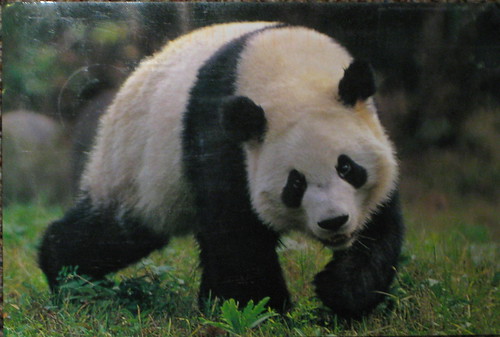
CN-209297

Vacation RR from Yue
Giant pandas are native to western China. Although they eat meat occasionally, 99% of their diet is bamboo. They are an endangered species, with around 2000 pandas living in the wild, mostly in Sichuan province, where there is a panda protection zone, according to the sender of the middle card above. The Sichuan reserve is a UNESCO world heritage site since 2006. The Sichuan pandas comprise one subspecies; the other subspecies lives exclusively in the Quinling Mountains in Shaanxi province. The Chinese government used loans and gifts of pandas to other nations throughout the 1970s in what became known as "panda diplomacy." Pandas are still loaned to other nations, but with strict terms - US$1 million per year, and any cubs born during the loan belonging to China.

The one on the right, issued in a 2002 set of two, shows the Ala Shan Redstart (Phoenicurus alaschanicus), a near-threatened bird endemic to China.
The stamps to the left and in the middle, below, are from a 2004 set of four depicting "new look of hometowns of overseas Chinese." The left one shows Xinlong overseas Chinese farm, and the middle one shows Kaiping, a hometown of overseas Chinese.
Finally, below on the right is a 1998 stamp from a set of four on Shennongjia, a forestry district in Hubei province. This one is titled "Primitive Forest."